

How to Improve Memory and Remember What You Study
Have you ever studied a chapter carefully but struggled to remember it during a test? Many students experience this problem. Sometimes, the challenge is not how…
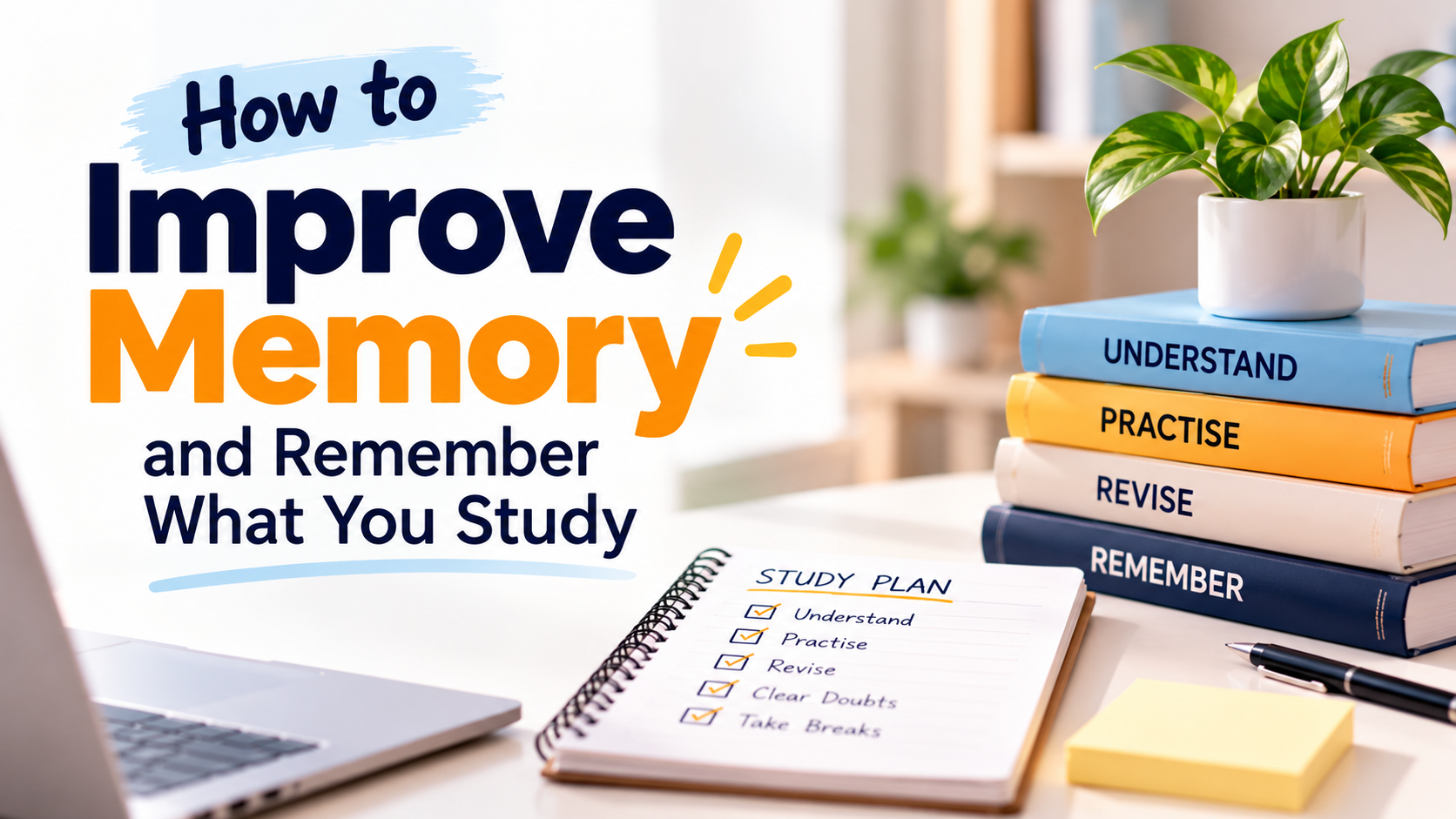
Have you ever studied a chapter carefully but struggled to remember it during a test? Many students experience this problem. Sometimes, the challenge is not how much you study but how effectively you learn and revise the information.
1. Understand Before You Memorise
One of the most effective ways to remember information is to understand the concept instead of simply memorising sentences.
When you understand why something happens or how a concept works, it becomes easier to connect it with what you already know. Try explaining difficult topics in your own words or using simple examples from everyday life.
2. Practise Active Recall
Active recall means testing yourself instead of repeatedly reading your notes. After completing a topic, close your book and try to remember the important points.
- Ask yourself questions about the chapter.
- Write down everything you remember.
- Try answering questions without looking at the textbook.
- Check your answers and identify missing information.
This technique helps you identify what you have understood and which topics need more revision.
3. Revise at Regular Intervals
Studying something once may not be enough to remember it for a long time. Spaced repetition involves revisiting information at planned intervals rather than trying to revise everything in one sitting.
For example, you can revise a topic on the day you learn it, revisit it the next day, and then review it again after a few days. Adjust the schedule according to how well you remember the material.
4. Make Short Notes and Mind Maps
Long paragraphs can sometimes make revision difficult. Short notes, diagrams and mind maps help organise information into smaller, meaningful sections.
Highlight key concepts, write important formulas and connect related ideas. Keep your notes simple so you can revise them quickly before tests and examinations.
5. Practise What You Learn
Reading alone does not always help you remember how to apply a concept. Practising questions, solving problems and attempting quizzes can strengthen your understanding.
- Solve textbook exercises after each chapter.
- Attempt practice questions and quizzes.
- Use sample papers to test your knowledge.
- Review mistakes and understand the correct method.
Regular practice is especially useful for subjects such as Mathematics and Science, where understanding and application go together.
6. Get Enough Sleep and Take Breaks
Good study habits also include taking care of your health. Sleep plays an important role in memory and learning. Staying awake for long hours to study may leave you tired and affect your concentration.
Take short breaks between study sessions, maintain a regular sleep schedule and include physical activity in your daily routine. These habits can support better focus and overall well-being.
7. Reduce Distractions While Studying
Frequent interruptions can make it harder to concentrate on new information. Choose a quiet study space, keep unnecessary devices away and focus on one task at a time.
You can try studying in short, focused sessions with clear goals. For example, complete one topic or a set of questions before moving to the next task.
8. Clear Your Doubts Instead of Ignoring Them
When you do not understand a concept, it can become difficult to remember related information. Instead of memorising an explanation without understanding it, take time to clear your doubts.
Ask your teacher, discuss the topic or use reliable learning resources to understand it better. A strong understanding makes future revision more meaningful.
How VLM Academy Supports Smarter Learning
Every student learns differently, and effective learning involves understanding, practice and regular revision.
VLM Academy brings together AI-powered learning tools, educational resources, practice activities and teacher-support features to help students with their academic journey.
Students can also explore the VLM Academy Student App to discover available learning resources and practice tools.
Frequently Asked Questions
How can I improve my memory for studying?
Focus on understanding concepts, practising active recall, revising at regular intervals and getting enough sleep. Consistency is more useful than last-minute memorisation.
Why do I forget what I study?
Forgetting can happen when information is not revised, understood or practised regularly. Distractions, fatigue and insufficient sleep can also affect learning and recall.
Is reading notes again and again enough to improve memory?
Repeated reading can help with familiarity, but it is useful to combine it with active recall, practice questions and spaced revision.
What is the best revision technique for students?
There is no single best technique for everyone. Active recall and spaced repetition are useful approaches that students can combine with notes, mind maps and practice questions.
Conclusion
Learning how to improve memory is not about studying for endless hours. It is about using effective techniques, understanding concepts and revising consistently.
Start with small changes: test yourself after studying, revisit difficult topics, practise regularly and maintain healthy routines. Over time, these habits can help make learning more effective and build confidence in your studies.
Remember: Study to understand, revise to retain and practise to improve.